Beware of "Purity Societies"...

A warning from Josephine Butler to the New Abolitionists.

Image: Northumberland Archives: Photograph of a painting of Josephine Grey, no date, ref: NRO 06655/1/70
On 3rd February 2026, the MSP Ash Regan’s ‘unbuyable’ bill was defeated in the Scottish parliament by 64 votes to 54. The proposed legislation would make the purchase of sexual services a criminal offence in Scotland, while decriminalising the sale - the so-called ‘Nordic Model’. The Scottish government’s refusal to back the bill, despite “agreeing with its principles” was due to concern that sex workers would be at “higher risk of violence” if it were enacted.
This was a rare and welcome victory for those who support decriminalisation, and oppose the Nordic Model.
At JBS we support decriminalisation not, as our critics claim, because we are “pro sex work”, but because we believe it is the legal model most conducive to sex worker safety. We accept that in an unequal society people will sell sex out of economic necessity, and we should therefore be taking a harm reduction approach. We oppose the Nordic Model because, based on the evidence from similar countries that have introduced it, like France and Ireland, it increases the risk of violence and exploitation of sex workers, not the other way around.
Supporters of the Nordic Model unfortunately believe that anyone advocating for decriminalisation is an apologist for sexual violence and exploitation. A member of the “pimp lobby” as they fondly refer to us. The fact that the “pimp lobby” includes the vast majority of sex worker led organisations around the world, as well Amnesty International, Human Rights Watch, the World Health Organization and The Royal College of Nursing, to name a few, seems not to faze them.

Image: Getty Images - Independent MSP Ash Regan introduced the bill to Holyrood
Josephine Butler is often cited by Nordic Model advocates as an inspiration for their campaign. Clearly there is a belief among this group that, were she still alive, she would support their cause.
The question of what Josephine would make of the world now is one we often reflect upon at JBS. It’s impossible to know for sure - she died in 1906, twelve years before women secured the vote, and over half a century before the social revolution of the 1960s. From Josephine’s time to now this country, and with it our common understanding of decency, respectability and morality, has completely changed.
One thing we do know however, is that she was no stranger to the kind of schisms in feminist activist circles that we see today.
The late 19th century saw deep divisions appear between groups that had previously worked together, under Josephine’s leadership, on the successful campaign to repeal the Contagious Diseases Acts.
They had also fought side by side to raise the age of consent from 13 to 16, in the face of shocking revelations of the extent of child trafficking and forced prostitution in Britain.
While we can’t say with certainty what Josephine would make of the current debate, looking into the public disagreements she had with some of her former campaign colleagues may go some way to giving us insight.
The “Pure” Society
The Contagious Diseases Acts were finally repealed in 1886, and the age of consent raised under the Criminal Law Amendment Act 1885.
At the same time momentum was also building behind the “social purity feminists” - predominantly educated, middle and upper class women who feared what they saw as the rise of “immoral behaviour”.
Drinking, gambling, sex work, and other activities associated with the “casual poor” undermined the social fabric of society, and needed to be stamped out by the moral zeal of figures like Laura Ormiston Chant, founder of the National Vigilance Association (NVA).
As well as raising the age of consent, the Criminal Law Amendment Act also outlawed brothel keeping. After the government’s disastrous attempts to regulate sex work during the period of the Contagious Diseases Acts, this volte-face saw a dramatic rise in the number of prosecutions and closures, which continued through the 19th and early 20th centuries. This was cheered on by the NVA, who warned of letting properties to “suspect women” through fear that they intended to use them for sordid purposes.
This resulted in not just sex workers being excluded from housing, but also many single working class women, who in the eyes of many of the social purists were guilty of living “fast lives” simply by virtue of their circumstances. Ironically, this often pushed them into the arms of pimps and other abusive men, in a desperate attempt to appear more “respectable”.
The NVA were also closely allied to the British Temperance Women’s Association, led by Lady Isabella Somerset, as well as titanic reforming figures of the age like Millicent Fawcett and Florence Booth. They believed that the streets needed to be cleaned up and, through their close relationship with the police and Home Office, encouraged “vigorous action to clear the streets of prostitutes”. This meant using the law to target sex workers, leading to prosecutions for “vagrancy”, “indecency” and “annoyance”.

Image: Police Constable Endacott Arrests Miss Cass. From The Illustrated Police News. Copyright, The British Library Board.
In 1885 the repeal of the Contagious Diseases Acts was close at hand, but the divisions between Josephine and her more “repressive” campaign colleagues were beginning to show. Despite their disagreements Josephine was still keen to emphasise unity, and in a speech at Exeter Hall in London she said:
These people are not our enemies… mistaken as we think they are in their methods, they are still honestly desirous of getting rid of prostitution… the advocates for the Contagious Diseases Acts desire the very opposite. They believe prostitution to be a necessity… It is the fervent desire of my heart to win and gain over entirely to our side all that crowd of repressionists who are now… going in a distinctly wrong direction.
In the years following repeal, Josephine’s hope of maintaining unity began to fade. She was particularly concerned with the actions and the rhetoric of the NVA in respect of the Criminal Law Amendment Act and its use in the closure of brothels.
Ten years after the repeal of the Contagious Diseases Acts, and following the sustained campaigns against “immorality” of the social purity feminist groups, Josephine’s patience seemed to have run out. She warned her colleagues:
Beware of ‘Purity Societies’… ready to accept and endorse any amount of inequality in the laws, any amount of coercive and degrading treatment of their fellow creatures in the
fatuous belief that you can oblige human beings to be moral by force.
The Convenience of Ignorance
One of the fatal flaws in the position of Nordic Model advocates is their refusal to talk to sex workers themselves. They do this, I imagine, because it is terribly inconvenient when the population whom you claim to be trying to protect almost unanimously opposes you. The English Collective of Prostitutes (ECP), the oldest sex worker led organisation in Britain, says of the Nordic Model:
Criminalising clients will not stop prostitution, nor will it stop the criminalisation of women. But it will make it more dangerous and stigmatising for sex workers.
It is also opposed by the Sex Workers Advocacy and Resistance Movement (SWARM), the Sex Workers Union, and National Ugly Mugs (NUM) the UK’s leading sex worker safety organisation.
Far from refusing to speak sex workers, Josephine instead opened her home to them as a refuge. Firstly in her house in Oxford that she shared with her husband and greatest supporter George, then when she moved to Bristol, and again when the family moved to Liverpool after the tragic loss of their four year old daughter.
In 1866, while in Liverpool, she set up one of the first refuges for marginalised women. This included sex workers but also other victims of a sexist and inherently unequal society - such as single working class women that had been seduced by male employers, fallen pregnant, and then been cast out. Exactly the type of people who would later be labelled by the social purity feminists as “suspect women”. Josephine’s hostel was famed for the way that residents were treated with love rather than judgement, and cared for rather than punished for their immorality.

Imagine: Wikipedia Commons: Josephine Butler, Pontefract, meeting notice.
Let’s be clear, Josephine Butler was not some proto sex-positive, bra-wielding feminist. Her religious and cultural values undoubtedly led her to be deeply troubled by the sex industry in all its forms. She clearly had nothing but contempt for the male clients of sex workers, and the fiercest of her criticisms were levelled against a political establishment that believed sex work to be a necessary evil.
We should also acknowledge Josephine’s initial desire to maintain unity, and respect for her former campaign allies.
Much of the NVA’s work included providing support to victims of sexual violence, including legal representation. They campaigned for the introduction of female magistrates and police officers, and for important changes to laws concerning sexual offences.
The temperance movements were driven by their outrage at the way in which domestic violence was fuelled by alcohol, and how husbands could be disposed to treat their wives so monstrously when they had been drinking.
There is no question that Josephine admired and applauded much of this. But she was also clearly troubled by the measures that repressive feminists were willing to take in their determination to abolish prostitution in its entirety.
The NVA and their allies believed that sex workers who did not wish to be “saved” by them had become demons themselves, and therefore deserved to have their livelihoods destroyed.
The New Abolitionists
Over a century later the debate is still raging. This time the abolitionists are not labelling sex workers as demons and suggesting they deserve to suffer if they do not wish to be “saved”. Now they consider anyone involved in the sex industry, specifically women, to be victims of exploitation and entirely without agency. It is the men who use the services of sex workers who are now the demons, and must be crushed with the full force of the law.
The new abolitionists framing is a classic fairy tale of good versus evil. In the face of the hideous reality of sex trafficking, and widespread rape and abuse experienced by those involved in the sex industry, they seek a simple narrative. Women in the sex industry are victims. Men who use sexual services are abusers. Therefore those willing to use the law to punish them are waging a just war.
The reality, as with most things in life, is much more complicated. And as difficult as it is to accept in our relentless world of forced binaries and fierce subcultural tribalism, multiple things can be true at the same time. A bit like how the NVA could have been a force for good and a force for harm. Or how the temperance movements could have been justified in their hatred of alcohol but also misguided in their methods for how to reform society. Or how Josephine Butler was clearly a wonderful and remarkable woman, whose views would today be considered patronising and paternalistic.
While plenty of people are trafficked and forced into prostitution, many more sell sex of their own accord. They may not enjoy it, they may even be doing so because they are in desperate financial straits, but they are still making a choice.
Plenty of clients of sex workers are bad people who seek their services as a way to exert power and control. Many others however do so because they are simply that, would-be clients seeking a service. There may be any number of reasons as to why they are doing this, and provided they are respectful and compliant with the sex workers conditions of service, in a free society, it is nobody’s business but theirs.
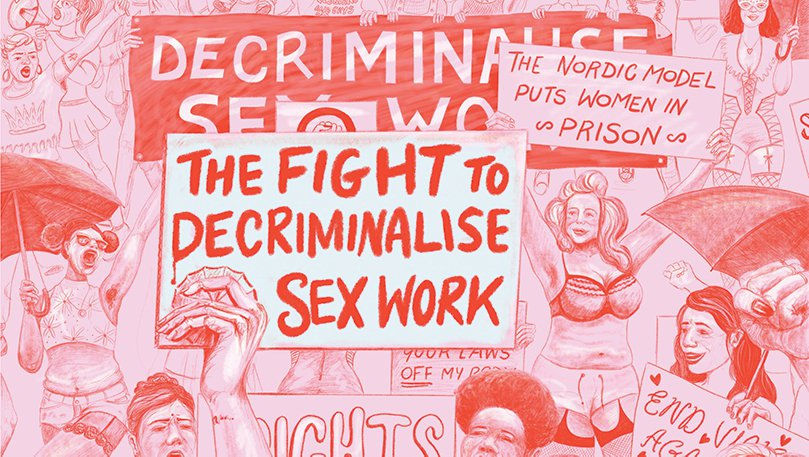
Imagine: DemocracyNow.org: Artwork by Carys Boughton. All rights reserved.
Sex workers repeatedly warn of the dangers of introducing the Nordic Model. The way in which it forces them to take greater risks in order to find work because potential clients are much less willing to provide personal information, or make themselves identifiable in any way. And clients that aren’t identifiable are much more likely to evade justice if they commit a crime against a sex worker. This is part of the reason why sex workers being able to use adult services websites (ASWs) to advertise makes their work much safer, because it’s so much easier to vet potential clients.
Nordic Model advocates argue that ASWs are hot beds of sex trafficking, and therefore want to shut them down. And sex workers in turn are forced to explain again and again that doing so would likely push them onto the streets, or into the arms of unscrupulous brothel managers. This is not theoretical. It is what happened when similar legislation came into effect in the US in 2018.
The NVA and other social purity feminists believed that the harm caused to sex workers and other marginalised women was a price worth paying for the higher purpose of abolishing prostitution. Josephine Butler profoundly disagreed, and I am confident that were she with us now, she would disagree with the new abolitionists for the same reason.
Not Evil, Just Wrong
The ‘unbuyable’ bill’s defeat in the Scottish parliament is a rare and welcome victory for supporters of decriminalisation. It serves as a reminder that there are enough politicians willing to listen to the very people affected by the legislation, and is hopefully an indicator that similar scrutiny and vigilance could be exercised when the issue inevitably rears its head again in Westminster. The new abolitionists are down but not out, and we must be ready and willing to stand up to them at every stage.
However, despite the intensity of emotion in this debate, and the bitterness of the divisions, we should heed Josephine’s words when she said “these people are not our enemies”.
Advocates of the Nordic Model are not inherently bad because of what they believe. They are misguided, and it is concerning how much potential damage they are prepared to cause in their determination to pursue their ideological goals. But they’re not evil, they’re just wrong.
And that’s ok. They can be wrong and not expect to be subjected to appalling online abuse, or the threat of violence, and the same goes for our side. It’s very sad to have to spell that out. It should be assumed that in a civilised, liberal democracy, we can have disagreements without threatening to annihilate each other. This is what we believe at JBS, as did the great woman from whom we take our name. Of that at least, we can be certain.